

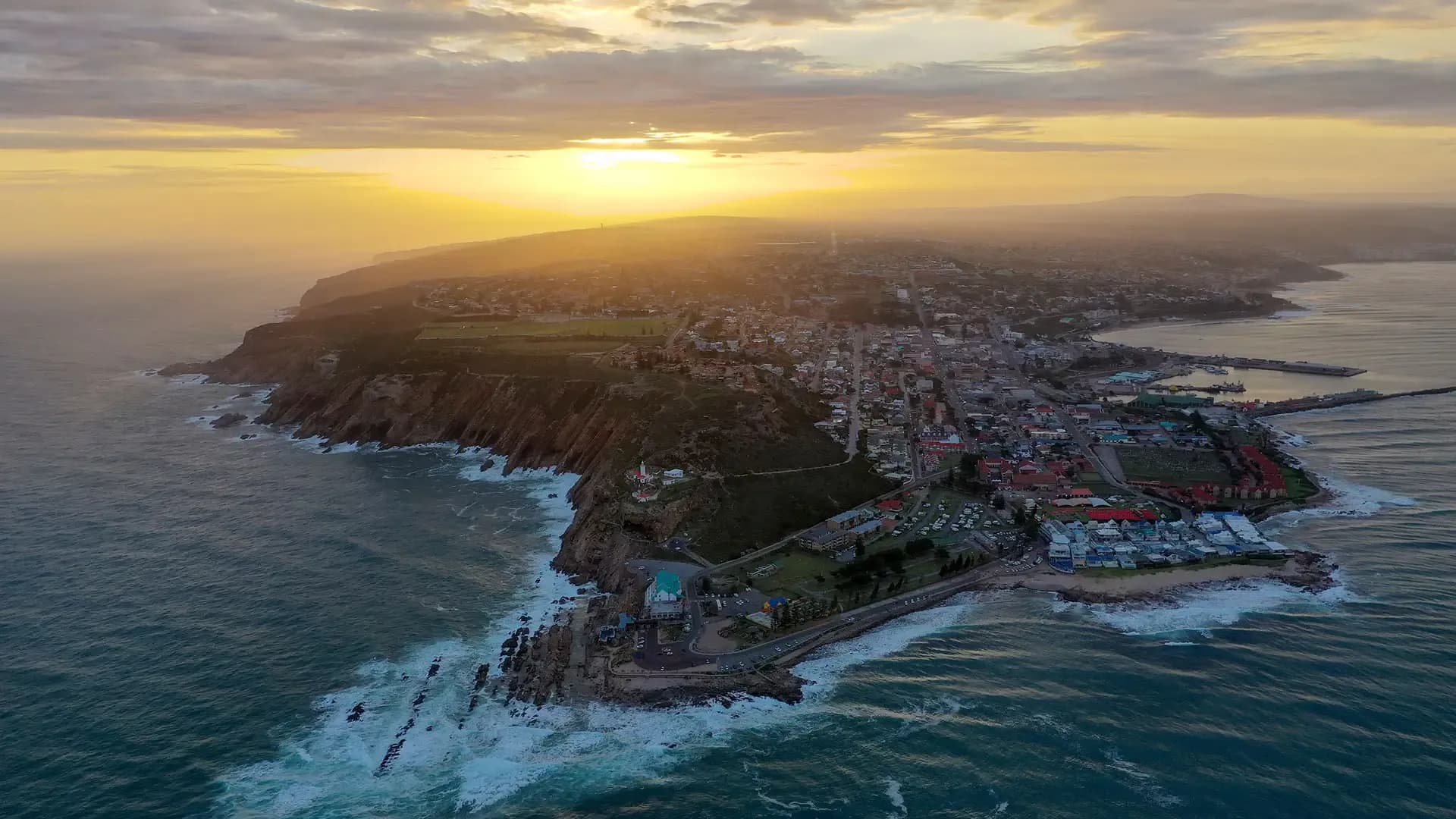
A light-hearted stroll through Mossel Bay history
Mossel Bay's recorded history goes back more than 500 years. Here it is, one era (and one fun fact) at a time.
First encounters: the Age of Exploration (1488–1601)
Mossel Bay first made its mark as a stop for some of history's great explorers. Portuguese ships looking for a sea route to India found water, food and sometimes trouble here. It's also where South Africa's first recorded "post office" took shape: a letter left in a shoe under a tree.
Key moments:
1488 (3 February): Bartolomeu Dias lands on the feast day of St Blaise and names the bay Aguada de São Brás, the watering place of St Blaise. Fresh water is found, but a skirmish with the Khoikhoi follows.
1497 (25 November): Vasco da Gama anchors in the bay. His crew trades with the Khoikhoi, and there's music and dancing on the beach.
1500: Pedro de Ataíde leaves a letter in a shoe hung on a milkwood tree, the beginning of the famous Post Office Tree.
1501: João da Nova finds the letter and builds a small chapel nearby.
1595: Cornelis de Houtman's Dutch fleet stops here and trades for sheep.
1601: Paulus van Caerden names the bay Mosselbaai after the mussels his crew found here.
Fun fact: you can still post a letter in the shoe-shaped post box beside the Post Office Tree, and it gets its own special postmark. The tree is now a provincial heritage site at the Dias Museum complex.
Settlers and outposts: the early colonial years (1652–1810)
As the Dutch East India Company tightened its hold on the Cape, Mossel Bay became a useful outpost for supplying ships. Farmers slowly moved into the district, and soldiers and traders put up the first permanent buildings.
Key moments:
1652: Jan van Riebeeck establishes a refreshment station at Table Bay, and Mossel Bay plays a supporting role.
1729: the first loan farm (leenplaas) in the district is granted at Hagelkraal.
1785: the Dutch East India Company sets up a military outpost in Mossel Bay.
1786: the Company builds the Granary to store wheat.
A town takes shape: from village to municipality (1811–1858)
In the early 1800s, Mossel Bay grew from a waystation into a community, with plots, shops, churches, schools and quays.
Key moments:
1811: Mossel Bay comes under the jurisdiction of George.
1820: land is surveyed, plots are laid out and the first buildings go up in Church Street. English settlers arrive.
1843–44: the first quays are built in Varkensbaai.
1845–47: the first Dutch Reformed (NG) church is built, and school lessons begin in its vestry.
1848: Mossel Bay becomes a town and magistrate's district.
1851: a horse-racing track opens at Boplaas.
1852 (12 July): Mossel Bay becomes a municipality, briefly under the name Aliwal.
1858: the first municipal building, the Market House, is built.
Boomtown by the sea: growth and stonework (1860–1899)
The late 1800s brought prosperity. Diamonds up north made Mossel Bay a busy harbour, stone buildings gave the town its signature look, and jetties, schools and reservoirs laid the foundations of the modern town.
Key moments:
1864: the Cape St Blaize Lighthouse is completed, and it still guides ships today.
1867: diamond discoveries in the interior send trade through Mossel Bay's harbour.
1869: the Robinson Pass opens, linking the coast to the Little Karoo.
1871: the first Mossel Bay Advertiser is published.
1874: the Queen's Warehouse is built to house customs offices.
1880: residents see electric light for the first time, aboard the visiting ship Trojan.
1883: the town's name officially goes back to Mossel Bay.
1887: Victoria Park is laid out.
Fun fact: the first electric light most residents ever saw came from a visiting ship, not the town itself.
Rails, phones and pavilions: the modernising era (1900–1929)
The new century brought railways, telephones, electricity and new places to gather.
Key moments:
1903: a telephone service is introduced.
1906: the railway line to Mossel Bay is completed.
1912: a community-funded hospital is built.
1916: the Santos Pavilion opens.
1922: electricity finally arrives, from a power station above Santos Beach.
1928: the rail bridge over the Gouritz River is completed.
Fun fact: Mossel Bay had telephones nearly 20 years before it had electricity.
Division and expansion: the mid-20th century (1950s–1970s)
As South Africa entered the apartheid era, Mossel Bay saw forced separation under the Group Areas Act alongside new housing, a provincial hospital and an offshore oil terminal.
Key moments:
1954: Tarka and New Sunnyside are declared "coloured" group areas.
1959: the provincial hospital opens in Linkside.
1960: an offshore oil terminal is commissioned at The Point.
1969: a replica padrão honouring the Portuguese explorers is erected above Munro's Bay.
Industry and heritage: the late 20th century (1980s–1990s)
Gas transformed the local economy, while the 500th anniversary of Dias's landing put Mossel Bay's heritage in the spotlight.
Key moments:
1987: the Mossgas gas-to-liquids (GTL) refinery project begins.
1988 (3 February): Mossel Bay marks 500 years since Dias's landing. A replica caravel sails in from Portugal to re-enact the voyage.
1989: the Bartolomeu Dias Museum opens, later home to the replica caravel. Construction of the refinery brings a big influx of workers.
1992: the GTL refinery is commissioned, one of the largest plants of its kind in the world at the time.
Fun fact: the replica caravel in the Dias Museum really did sail all the way from Portugal, just as Dias did 500 years before.
Into the 21st century: gas, uncertainty and growth (2000s–today)
Energy has kept Mossel Bay in the headlines, while tourism and events bring visitors year-round.
Key moments:
2019: TotalEnergies (then Total) and its partners announce the Brulpadda gas discovery off the south coast, followed by Luiperd in 2020.
2020: the GTL refinery stops production because it runs out of gas to process.
2024 (July): TotalEnergies announces it is withdrawing from the Brulpadda and Luiperd block, saying the finds would be too difficult to develop commercially.
2026: PetroSA tells Parliament in September that it is technically insolvent. It is still aiming to restart the refinery, with a target of late 2027.
Meanwhile, the town keeps growing as a holiday and events destination, from MosJazz to IRONMAN 70.3 Mossel Bay.
And so Mossel Bay's story runs from mussels and milkwood trees to gas rigs and museums, always balancing a rich past with new horizons. Explore it yourself with our local guide.